
Wise by Design
Equipping Minds for Excellence
"For I know the plans I have for you," declares the LORD, "plans to prosper you
and not to harm you, plans to give you hope and a future." - Jeremiah 29:11
Equipping Minds for Excellence
"For I know the plans I have for you," declares the LORD, "plans to prosper you
and not to harm you, plans to give you hope and a future." - Jeremiah 29:11
Wise by Design is an enhanced Christian executive function curriculum that integrates:
40+ years of research from SMARTS Executive Function Curriculum and Smart but Scattered principles
Theological depth connecting EF skills to spiritual formation throughout every lesson
Aligned with grammar, logic, and rhetoric stages of classical education
Recognizing that executive skills mature over time according to God's design
Students will develop 12 core executive function skills proven to enhance learning, understand these skills through a biblical worldview lens, see themselves as fearfully and wonderfully made by God, and grow in Christ-likeness through practical skill development.
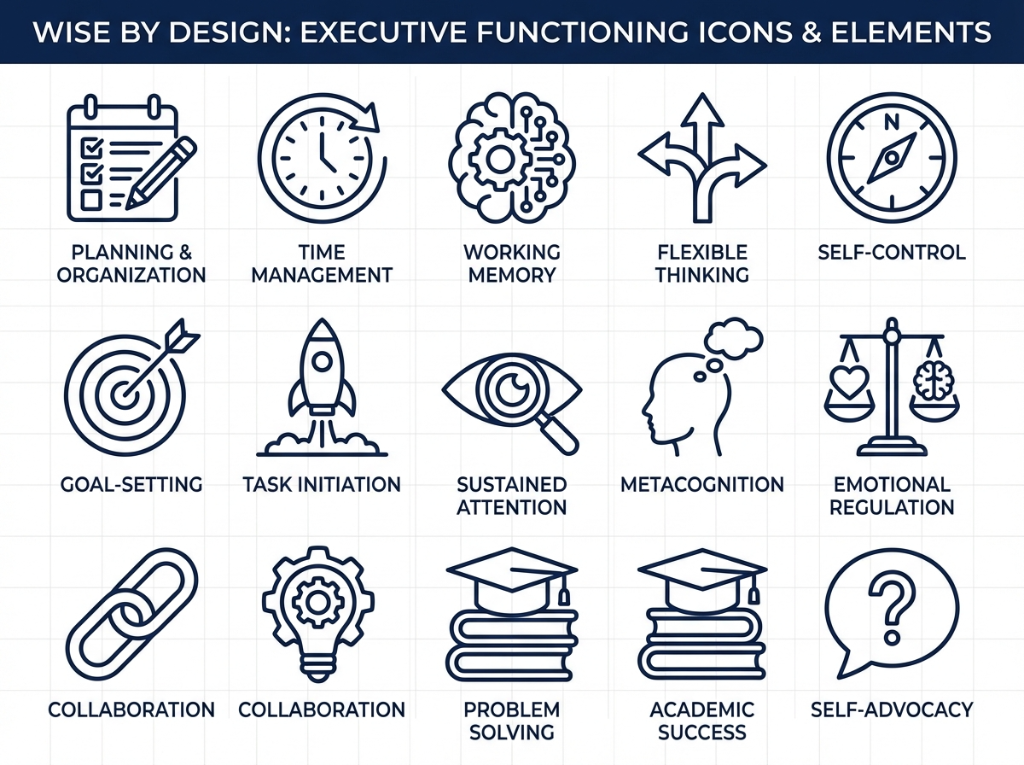
The twelve executive function skills provide a comprehensive framework for developing cognitive excellence rooted in biblical wisdom.
"I praise you because I am fearfully and wonderfully made; your works are wonderful, I know that full well." - Psalm 139:14
God has created each student with unique strengths, weaknesses, and purposes. Executive skills are part of this design, given to help us steward our lives well.
"When I was a child, I talked like a child, I thought like a child, I reasoned like a child." - 1 Corinthians 13:11
Executive skills develop over time—the prefrontal cortex isn't fully mature until the mid-20s. We extend the same grace God extends to us as students grow at different rates.
"The fear of the LORD is the beginning of wisdom." - Proverbs 9:10
The goal isn't perfect performance but growing wisdom—learning to apply God's truth in practical, daily decision-making.
"So whether you eat or drink or whatever you do, do it all for the glory of God." - 1 Corinthians 10:31
Executive skills enable faithful stewardship of time, talents, and resources—core biblical values.
"As iron sharpens iron, so one person sharpens another." - Proverbs 27:17
As the body of Christ, we support one another's growth, recognizing we are designed for interdependence.
"And we all…are being transformed into his image with ever-increasing glory." - 2 Corinthians 3:18
Executive skill development isn't separate from spiritual formation—it's an integral part of becoming more Christlike.
Many students experience what researchers call the "clogged funnel" problem:
The Truth: Students aren't failing because they're not smart. They're struggling because no one explicitly taught them HOW to manage the complexity of secondary school.
Each of the twelve executive function skills is rooted in biblical wisdom and connected to spiritual formation. These skills are organized according to five key SMARTS processes: Goal Setting, Cognitive Flexibility, Organizing & Prioritizing, Accessing Working Memory, and Self-Monitoring.
Biblical Virtue: Self-Control
"The heart of the righteous weighs its answers, but the mouth of the wicked gushes evil." - Proverbs 15:28
The capacity to think before acting, to pause and consider consequences before responding.
Biblical Virtue: Stewardship of the Mind
"Store up these words of mine in your hearts and minds." - Deuteronomy 11:18
The ability to hold information in memory while performing complex tasks.
A three-column note-taking method that deepens encoding:
| Big Ideas/Terms | Explanation | Memory Hook |
|---|---|---|
| Main concept or vocabulary | Define in own words | Personal mnemonic, cartoon, or association |
Biblical Virtue: Self-Control / Patience
"Better a patient person than a warrior, one with self-control than one who takes a city." - Proverbs 16:32
The ability to manage emotions to achieve goals or direct behavior.
Biblical Virtue: Humility
"Many are the plans in a person's heart, but it is the LORD's purpose that prevails." - Proverbs 19:21
The ability to revise plans in the face of obstacles or new information.
Biblical Virtue: Perseverance
"Let us run with perseverance the race marked out for us, fixing our eyes on Jesus." - Hebrews 12:1-2
The capacity to maintain attention despite distractions, fatigue, or boredom.
Developmental Note: Middle schoolers typically sustain 20-40 minutes; high schoolers 40-60 minutes.
Biblical Virtue: Diligence / Faithfulness
"Whatever your hand finds to do, do it with all your might." - Ecclesiastes 9:10
The ability to begin projects without undue procrastination.
Just start for 5 minutes. Often the hardest part is beginning; once started, momentum builds.
Make the first action ridiculously easy:
Biblical Virtue: Prudence / Wisdom
"The plans of the diligent lead to profit as surely as haste leads to poverty." - Proverbs 21:5
The ability to create roadmaps to reach goals and decide what's important.
"Suppose one of you wants to build a tower. Won't you first sit down and estimate the cost?" - Luke 14:28-30
Biblical Virtue: Orderliness
"But everything should be done in a fitting and orderly way." - 1 Corinthians 14:40
The ability to create and maintain systems for tracking information and materials.
Biblical Virtue: Stewardship of Time
"Making the most of every opportunity, because the days are evil." - Ephesians 5:16
The capacity to estimate, allocate, and stay within time limits.
Multiply time estimates by 1.5 (we consistently underestimate how long tasks take)
Schedule specific times for specific tasks (not just "do homework")
Biblical Virtue: Perseverance
"Let us not become weary in doing good, for at the proper time we will reap a harvest if we do not give up." - Galatians 6:9
The capacity to follow through to completion without being deterred.
Break long-term goals into visible milestones with celebration at each checkpoint
Practice resisting short-term temptations for long-term rewards
Biblical Virtue: Self-Examination
"Search me, God, and know my heart; test me and know my anxious thoughts." - Psalm 139:23
The ability to observe oneself and evaluate problem-solving.
Biblical Virtue: Trust / Resilience
"Cast all your anxiety on him because he cares for you." - 1 Peter 5:7
The ability to thrive in stressful situations and cope with uncertainty.
Help students create personalized "toolboxes":
The prefrontal cortex—the biological seat of executive function—is the "hardware" through which the Holy Spirit produces self-control (Galatians 5:23).
| Executive Skill | Biblical Virtue | Scripture |
|---|---|---|
| Response Inhibition | Self-Control | Proverbs 29:11 |
| Planning | Prudence | Proverbs 21:5 |
| Flexibility | Humility | Proverbs 19:21 |
| Self-Monitoring | Self-Examination | Lamentations 3:40 |
| Persistence | Perseverance | Galatians 6:9 |
"Fearfully and Wonderfully Made"
CANDO Goals, Pre-Mortem Planning, Persistence
FLEX Protocol, Perspective-Taking
4 C's Organization, Triple-Note-Tote
ERAS, I-SEE Framework, Top 3 Hits
Pomodoro, Focus Zones, 5-Minute Rule
CALM Response, Stress Management
Future Planning, Progress Recognition
Each week includes multiple tiers of instruction and support:
| Component | Frequency | Duration | Audience |
|---|---|---|---|
| Tier 1 Whole-Class Lessons | 2x per week | 30 minutes | All students |
| Tier 2 Small Group Sessions | 2-3x per week | 20 minutes | Targeted students (15%) |
| Tier 3 Individual Coaching | 2-3x per week | 20-30 minutes | Intensive support (5%) |
| Daily Skill Reinforcement | Daily | 5 minutes | Integrated in subject classes |
| Parent Communication | Weekly | - | Home practice activities |
Learning Objectives: Understand the "clogged funnel" problem, remove shame by understanding EF vs. intelligence, identify the "hidden curriculum"
Key Activity: The Funnel Demonstration - Pour water (intelligence/ideas) through funnel with wide top, narrow neck to show academic underachievement
Learning Objectives: Understand prefrontal cortex development timeline, learn about developmental grace, recognize external strategies as "prosthetic frontal lobes"
Key Concept: The prefrontal cortex isn't finished until mid-20s. Checklists, planners, alarms = external supports while brain is under construction.
Learning Objectives: Learn the 12 Wise by Design skills, understand how they map to 5 SMARTS processes, begin identifying personal strengths and growth areas
Key Activity: The Orchestra Metaphor - Compare orchestra tuning (chaos) vs. playing symphony (harmony). EF is like the conductor.
Learning Objectives: Complete full Wise by Design Skills Survey, understand personalized learning profiles, begin strategy notebook
Key Activity: Create Learning Profile Card with top 3 strengths, top 3 growth areas, and "I learn best when..." statements
Learning Objectives: Connect each EF skill to corresponding biblical virtue, understand how strengthening EF builds Christlikeness
Key Teaching: When you practice stopping before you speak, you're strengthening the same neural pathways the Holy Spirit uses to produce self-control.
Learning Objectives: Study Nehemiah as case study in executive function, learn "What Would Nehemiah Do?" planning protocol
Key Framework: Goal Setting (clear vision), Planning (night survey, calculated resources), Organization (assigned families to wall sections), Flexibility (armed builders when threatened), Persistence (refused distractions)
This comprehensive assessment helps identify a student's executive function strengths and growth areas through quantitative measurement across all 12 skills.
Three Perspectives for Complete Picture:
Multiple perspectives provide the richest, most accurate picture of student functioning across contexts.
Raw scores for each skill (3 questions × 7-point scale = max 21 points) are translated into proficiency bands:
| Total Score (Max 252) | Overall EF Profile | Interpretation |
|---|---|---|
| 216-252 | Strong across domains | Few EF challenges; Tier 1 sufficient |
| 180-215 | Generally adequate | Some areas need attention; mostly Tier 1 |
| 144-179 | Mixed profile | Significant variability; Tier 2 for weak areas |
| 108-143 | Multiple challenges | Many areas weak; Tier 2 or 3 needed |
| 36-107 | Pervasive EF difficulties | Comprehensive Tier 3 support essential |
In addition to formal surveys, observe students in natural settings. Look for these specific behaviors:
Wise by Design uses a three-tiered Multi-Tiered System of Supports (MTSS) framework to ensure all students receive appropriate support levels based on their specific needs.
WHO: All students (80%)
DELIVERY:
FOCUS:
WHO: Students with specific weaknesses (15%)
DELIVERY:
FOCUS:
WHO: Students with significant EF challenges (5%)
DELIVERY:
FOCUS:
A specialized approach for students requiring intensive support:
Educational therapist demonstrates the strategy with detailed think-alouds
Student applies with scaffolded support and coaching
Student uses strategy independently across all classes
Goal: Generalization across all classes with greatest possible independence
"Search me, God" - Identify skill levels through surveys and observation
"Plans succeed with many advisers" - Create customized intervention plan
"Work with all your heart" - Put strategies into practice with consistency
"Examine our ways" - Track progress and celebrate wins
"The prudent see danger ahead" - Modify based on outcomes
"Train up a child in the way he should go; even when he is old he will not depart from it." - Proverbs 22:6
Executive function development requires consistent practice across settings. Parents are essential partners in reinforcing skills taught at school.
Your child is not lazy, unmotivated, or being deliberately difficult. Executive function weaknesses are neurological, not character flaws. These skills develop over time with support and practice, just like learning to read or play an instrument.
Transform your communication from nagging to coaching:
| Instead of... | Say... |
|---|---|
| "Did you do your homework?" | "What's your CANDO goal for homework tonight?" |
| "You're so disorganized!" | "Let's use the 4 C's to clean your backpack together." |
| "Why didn't you study?" | "What got in the way? Let's do a pre-mortem for next time." |
| "You never remember anything!" | "What memory strategy worked for you last time?" |
| "Stop procrastinating!" | "Let's use the 5-Minute Rule to get started." |
| "You need to focus!" | "Let's set up your focus zone and try one Pomodoro." |
Each week, the school sends home a specific practice activity aligned with the current lesson. Examples:
The teacher training follows a three-phase "Learn Today, Teach Tomorrow" model that emphasizes practical, hands-on application, just-in-time learning aligned with upcoming units, and immediate classroom use.
Outcome: Teachers leave with deep understanding of philosophy, ready-to-teach first 3 weeks of lessons, assessment tools, and confidence to begin.
Following a four-week cycle, teachers receive ongoing support:
These workshops are offered throughout the year to deepen expertise:
External coach provides monthly support
Internal teacher leaders emerge
Full sustainability achieved
All teachers receive comprehensive strategy notebooks containing:
This "Wise by Design" system represents more than just skill development—it's discipleship in action. As students grow in their executive functioning abilities, they don't become merely more efficient; they become more effective servants of Christ.
"Do not be conformed to this world, but be transformed by the renewal of your mind, that by testing you may discern what is the will of God, what is good and acceptable and perfect." - Romans 12:2
We envision students who:
This is not about creating perfectly organized students who can check all the boxes. This is about forming Christ-like individuals who use their God-given cognitive abilities to love God with all their minds and love their neighbors as themselves.
"Whatever you do, work at it with all your heart, as working for the Lord, not for human masters." - Colossians 3:23